




Moving Into a Toronto High-Rise? Here's What to Know Before Moving Day

Moving into a Toronto high-rise is a different experience than moving into a house. The logistics are more constrained, the building has rules you need to follow, and there are variables — elevator availability, loading dock access, parking — that can derail your entire moving day if you haven't sorted them out in advance.
This isn't a scare tactic. High-rise moves in Toronto go smoothly every day. But the ones that go smoothly have one thing in common: the person moving had done their homework before the truck arrived.
Here's everything you need to know.
Why High-Rise Moves in Toronto Are Different
When you move into a house, your main constraints are the front door width, any stairs, and the size of the truck. In a Toronto condo or apartment building, the list of variables is longer.
Most high-rises have a single service elevator designated for moves. That elevator is shared with everyone else in the building who needs it. If you haven't booked it — or booked it for the wrong time — you could find yourself waiting while someone else finishes their move, adding hours to your day.
Loading docks and service entrances have their own constraints. Many buildings only allow moving trucks to access the loading dock during specific hours. Some have height restrictions that affect which trucks can enter. In dense Toronto neighbourhoods, the street outside might not have space for a large truck at all without advance notice to the city.
Then there's the hallway factor. High-rise corridors are built to exact fire code widths. Furniture that fits fine through a house doorway might not clear a tight condo corridor — especially on turns. Knowing your measurements in advance prevents the genuinely unpleasant experience of having a sofa stuck in a hallway on the 22nd floor.
None of this is insurmountable. All of it requires advance planning.
Step One — Contact Your Building Management Before Anything Else
As soon as your move date is confirmed, contact your building's property management office. This is the single most important thing you can do, and it should happen weeks ahead of moving day — not the week before.
What to ask them:
How do you book the service elevator, and what are the available windows? Most Toronto condos and high-rises require you to reserve the elevator in advance. Popular dates — particularly end-of-month weekends — fill up fast. Some buildings only offer two or three moving windows per week.
Is there a moving deposit required? Many buildings require a refundable damage deposit, typically $200–$500, held against any damage caused to hallways, elevator interiors, or common areas during the move. You'll need to pay this before your move date.
What are the loading dock hours and access requirements? Some loading docks are first-come, first-served; others require advance booking. Many have height restrictions — typically 8 to 10 feet — that affect which vehicles can access them. Pass this information directly to your moving company.
Are there any restrictions on move times? Most Toronto residential buildings restrict moves to daytime hours, often 8 AM to 5 PM or 9 AM to 6 PM on weekdays, with more restricted hours on weekends. Some buildings prohibit moves on Sundays and statutory holidays entirely.
What's the fastest route from the loading dock to your unit? This is worth asking specifically. Service entrances often lead to a different bank of elevators than the main lobby, and knowing the route in advance helps your movers work efficiently.
Elevator Booking — What You Need to Know
The service elevator is almost always the biggest logistical factor in a high-rise move, and it's the one most people underestimate.
In most Toronto buildings, you book a moving window — typically three to four hours — and the elevator is padded and reserved for your exclusive use during that time. When your window ends, it's released. If your movers are still working, they lose elevator priority.
This means two things. First, book the longest window your building allows, not the shortest. Even if you think your move will take two hours, give yourself four. Second, share the building's elevator booking confirmation with your movers before moving day so they understand the time constraint.
If your building has a freight elevator and a passenger elevator, ask specifically whether the freight elevator is available for your move. Freight elevators are larger and typically better suited for furniture and appliances.
What happens if you don't book: You'll still be able to move — the building can't physically stop you from using the elevator — but you'll be sharing it with other residents, waiting for each trip, and possibly creating conflict with the building's own maintenance and delivery operations. On a time-sensitive moving day, this is a significant problem.

Measurements — Do This Before You Pack Anything
Every high-rise has a different layout, and the measurements that matter are not always obvious.
What to measure at your new unit:
The service entrance door width. This is often narrower than the front entrance. Many Toronto buildings have service doors in the 32–34 inch range — tight enough that standard furniture requires turning.
The corridor width and any turns between the elevator and your unit door. A long sofa that fits through the door can get stuck on a hallway corner. If there's a particularly tight turn, measure the inside radius.
Your unit door width. Standard condo doors are typically 32–34 inches. If you have large furniture pieces — king bed headboards, sectionals, oversized wardrobes — measure them against the door width before moving day.
Ceiling height in the elevator. This affects anything tall: large bookshelves, floor mirrors, mattresses stood on their side. Measure the elevator interior height and compare it to your tallest items.
Pass these measurements to your movers when you book. A professional moving company will know how to handle tight spaces, but they work more efficiently when they know the layout in advance. If something genuinely won't fit, better to know now so you can make a decision — disassemble it, sell it, or arrange alternative access.
Parking and Street Access — The Overlooked Variable
In a Toronto house move, parking for the moving truck is usually straightforward. In a dense urban neighbourhood with a high-rise building, it can be complicated.
Many Toronto condo buildings have a loading dock accessible from a side street or laneway. Find out exactly where it is and whether there are any size or weight restrictions. If the loading dock is too small for the truck or has a height barrier, the truck will need to park on the street — and depending on your neighbourhood, that may require a temporary no-parking permit from the City of Toronto.
Toronto permits for temporary no-parking zones (sometimes called "parking prohibition" permits) can be obtained through the City's 311 service or online. They typically need to be requested at least a week in advance and cost a small fee. Your moving company may be able to handle this for you — it's worth asking when you book.
If your building is in a neighbourhood with heavy daytime traffic (downtown, Midtown, the Entertainment District), morning moves starting at 8 AM tend to go more smoothly than afternoon ones when traffic and street congestion are worse.
What to Pack —
and What Not to Bring Up Until the Elevator Is Free
High-rise moves reward a specific packing approach. Because every trip to your unit requires elevator time, efficiency matters more here than in a house move.
Box everything that can be boxed. Loose items — a lamp with no box, a pile of cushions, individual bags — slow down elevator trips. In a house, you can make ten quick trips with small loads. In a high-rise, every trip costs elevator time. Consolidate everything into boxes or bags before moving day.
Label boxes with the room and priority. Your movers will ask where things go. Having boxes clearly labeled ("Primary bedroom — books" or "Kitchen — fragile") means they don't need to ask about every item and can work through the elevator window efficiently.
Separate your essentials. Pack a bag that travels with you — not in the elevator load — containing medications, phone chargers, a change of clothes, important documents, and a few kitchen items for your first night. In a high-rise move, the last thing you want is to realize your essentials are buried in a box somewhere in the unit while the movers are still unloading.
Decide in advance where furniture goes. In a house, you can move furniture around after the movers leave. In a high-rise, once the elevator window closes and the movers are gone, repositioning a heavy piece requires either doing it yourself or scheduling a return. Have a rough floor plan in mind before moving day.
Protecting Your Building — Deposits and Liability
Most Toronto condos require a moving deposit before your move date. This is held against any damage caused to the building's common areas — elevator walls and floors, corridor walls, door frames — during the move.
The deposit is typically refunded within a few days of the move, provided there's no damage. To protect yourself:
Before moving day, photograph any existing damage in the service elevator, the corridors leading to your unit, and the lobby entrance. Send these photos to the building management by email so there's a timestamped record. If there's a scuff on the elevator floor before your movers arrive, you don't want to be responsible for it.
After moving day, do a walkthrough of the common areas and notify building management immediately if any new damage occurred. Prompt communication resolves these situations much more easily than disputes after the fact.
Your moving company should carry liability insurance that covers damage caused during the move. Confirm this when you book — a reputable apartment moving service will carry standard liability coverage as a matter of course.
The Day Before — A Final Checklist
The day before your Toronto high-rise move, run through this list:
Building logistics confirmed:
- Service elevator booked and confirmation in hand
- Moving deposit paid to building management
- Loading dock access confirmed with building and with your movers
- Street parking or city permit arranged if needed
- Move time window shared with your movers
Packing complete:
- All boxes sealed, labeled, and ready in an accessible area
- Furniture disassembly done (or noted for movers to handle)
- Appliances disconnected (fridge defrosted at least 24 hours in advance)
- Essentials bag packed and set aside
Measurements confirmed:
- Your movers have the elevator dimensions, corridor measurements, and any access restrictions
First night prepared:
- Bedding, towels, and toiletries accessible (not buried in boxes)
- Coffee maker and basic kitchen items in your essentials bag
- Phone charged and charger in the essentials bag
Working With Professional Apartment Movers in Toronto
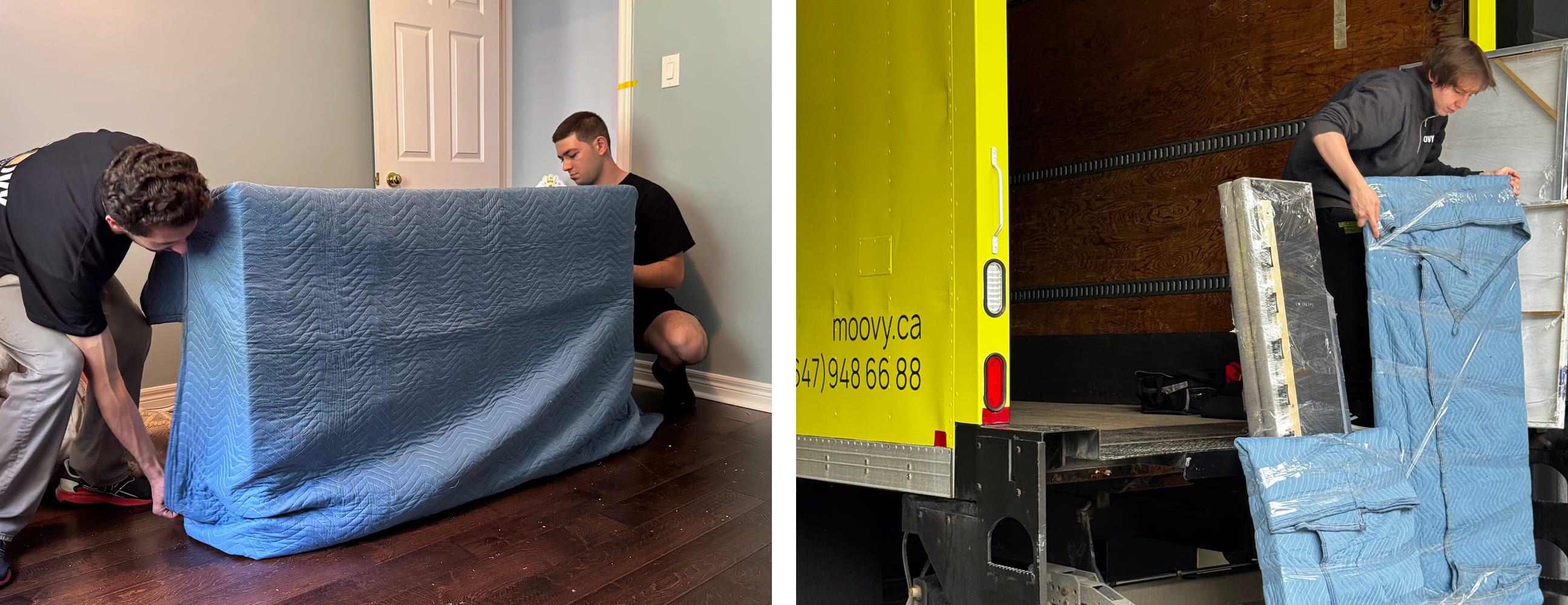
High-rise moves are not the right time for DIY. The combination of elevator windows, deposit liability, tight corridors, and heavy furniture in a time-constrained environment is exactly what professional movers are built to handle.
Moovy's apartment moving service covers the full scope of a high-rise move: furniture disassembly and reassembly, packing, heavy items, and all the loading and unloading. All moving supplies, tools, and blankets are included — there's no separate charge for materials.
Rates start at $119 per hour for two movers, with a three-hour minimum plus a truck fee. No deposit is required to book, and there are no fuel surcharges or hidden fees. Free shipping applies across Toronto and the GTA.
If you're also moving from a house rather than between apartments, Moovy handles house moves as well — including moves that involve both types of properties. For moves outside the immediate Toronto area, long-distance moving across Ontario is also available.
Request a free quote or call +1 (647) 948 66 88 — the team typically responds the same day.
Quick Reference — Toronto High-Rise Moving Timeline
6–8 weeks before: Contact building management, book service elevator, pay moving deposit, book your movers
3–4 weeks before: Measure elevator, corridors, and unit doorways; pass measurements to movers; arrange parking permit if needed
2 weeks before: Begin packing non-essentials; confirm all building logistics in writing
1 week before: Confirm all details with your moving company; complete major packing; defrost fridge 24–48 hours before move
Day before: Final checklist; pack essentials bag; confirm start time with movers
Moving day: Be present for loading and unloading; do a final walkthrough before the truck leaves; photograph building common areas before and after
Toronto high-rise moves have more moving parts than most people expect — but every one of those parts is manageable with the right preparation. Start with your building management, book your elevator early, get your measurements right, and work with a moving company that knows the process.
Moovy also serves the GTA beyond Toronto — including Mississauga, Markham, Vaughan, and Brampton.