

Moving Out of an Older Toronto House: Two Real Moves and What They Taught Us

Older Toronto houses have narrow doors, tight stair turns and street parking, but big furniture almost always still gets through. On two real moves this fall a three-mover crew took a door off its hinges to get a sofa into a Leslieville semi (about 7 hours in total) and lowered an oak dresser from a Mimico balcony (about 8.5 hours). Measure, photograph the stairs and send your inventory before moving day.
Older Toronto houses are hard on moving day for three reasons: narrow front doors, staircases with a tight turn and a low landing, and no driveway. Big furniture almost always still gets out and in. It takes measuring before the day, the right crew size, and a crew that knows when to take a door off its hinges.
This fall our crews did two house moves that show exactly how that works. In one, a three-seat sofa met a front door built around 1910. In the other, a solid oak dresser could not get down a 1920s staircase at all and left through the back balcony. Below are both moves as they happened, with the crew size, the hours and the cost, followed by a checklist for anyone moving out of an older house in Toronto, Etobicoke or Mississauga.
Why older Toronto houses make moving day harder
Many of the houses in neighbourhoods like Leslieville, Riverdale, the Annex and south Etobicoke went up in the first half of the 1900s. People love them for the trim, the porches and the brick. The trouble is that they were built for the furniture of their time. A 1920s staircase was never meant to carry a 64-inch dresser or a deep sectional, and the pieces people buy today are bigger.
Front doors and storm doors
The front door of an older house is often only 30 to 32 inches wide, while newer houses often have 36-inch doors. Most of these houses also have a storm door in front of the main door, and an open door hanging in the frame takes another inch or two out of the opening. On a sofa that is 37 inches deep, those inches decide whether it goes in or stays on the porch.
Stairs with a turn and a low landing
The stairs are often the real bottleneck. A narrow staircase that turns 90 degrees at a small landing, with a ceiling just over six feet above it, stops tall and wide pieces in a way a straight run never does. A dresser can be too wide to turn flat and too tall to tip up under the ceiling. Basement stairs are often narrower still.
Street parking instead of a driveway
Plenty of older houses have no driveway, or a shared one. Then the truck parks on the street, and how close it gets to the door matters. On a house move the crew walks between the truck and the door hundreds of times. Every extra metre on that walk adds billed time.
None of this means you need a specialist or should leave your furniture behind. It means planning for it. Here is what that looked like on two real moves.
Move 1: a Midtown house to a Leslieville semi

The house, the inventory and the plan
Our clients were a couple leaving a two-storey, two-bedroom house near Yonge and Eglinton. They were moving into a semi-detached house in Leslieville, about 10 km away. The new place had original trim and a narrow front entrance.
They sent their inventory ahead of time:
- a queen bed and a double bed
- two dressers
- a dining table with four chairs
- a desk and a TV
- around 30 boxes they packed themselves
- a large three-seat sofa
With that list we could plan the crew and the time properly. The plan was three movers and our truck. At pickup the truck parked in the driveway, a few steps from the front door. At dropoff it had street parking right in front of the house. Blanket wrapping for every piece, mattress bags, floor runners and taking apart and putting back together both beds were part of the job.
Loading in Midtown
We call every client 30 minutes before arrival, and on this move the crew was there at 9 AM. After a quick walkthrough they laid floor runners in the hallway and started.
The furniture was wrapped in moving blankets and taped, and the mattresses went into bags. The beds came apart. We wrap each bed's bolts and hardware in plastic and tape them to the side rails, then wrap the side rails together as one bundle. That way nothing gets lost and reassembly starts as soon as the bundle comes off the truck.
The truck was in the driveway and the boxes were packed and labelled by room. So even with every bedroom piece coming down a flight of stairs, loading moved fast.
When the sofa met a 1910 doorway
The real test came in Leslieville. The sofa was about 88 inches long and 37 inches deep. The front doorway was barely 30 inches wide, with a storm door in front of it. The movers tried it upright, on its side and at an angle. It still caught on the door, which swung into the opening and took the space they needed.
So the crew took the door off. They pulled the hinge pins, lifted the door away and set the storm door aside. That gave about two more inches. They wrapped the door frame in blankets to protect the old trim. Then they stood the sofa on end and hooked it through the opening, back first, with one mover guiding it from inside.
It went through with a little room to spare. Both doors were back on their hinges a few minutes later, and nothing was scratched. The whole manoeuvre took about 25 minutes. The clients told us that watching it was the most stressful part of their day, and also the best moment of it.
The rest of the unload was routine. Every piece went into the room it belonged in, both beds were put back together, and the floor runners came up.
How long it took
The move took about 7 hours, from the crew's arrival in Midtown to the final walkthrough in Leslieville. The door removal added about 25 minutes. Without driveway parking at pickup and boxes packed in advance, loading alone could easily have taken an hour longer.
Move 2: a 1920s Mimico semi to a house in Port Credit
The house, the inventory and the plan
The second move was a family of four leaving a three-bedroom semi on a side street in Mimico, in south Etobicoke. The house was built in the 1920s. Its staircase turns 90 degrees at a small landing, and the ceiling over that landing is just over six feet high.
They were moving to a detached house in Port Credit, Mississauga, about 12 km west along the lake. The new house had a driveway and wide, straight stairs.
The inventory was a full family house:
- a king bed, a queen bed and a bunk bed
- a solid oak nine-drawer dresser, about 64 inches wide and 36 inches tall
- two smaller dressers and a wardrobe
- four night tables
- a sectional sofa, an armchair and a coffee table
- a 65-inch TV and a TV stand
- a dining table with six chairs and a sideboard
- a desk, an office chair and two bookshelves
- floor lamps, mirrors and framed pictures
- a patio table with four chairs and a barbecue
- about 45 boxes the family packed themselves
The plan was three movers and our truck on a Saturday morning. The old house had street parking only, so the night before the clients asked their neighbours to leave the two spots in front of the house free. In Port Credit the truck backed into the driveway. Blankets and tape on every piece, mattress bags, floor runners and taking apart and putting back together all three beds were part of the job.
The dresser that couldn't make the turn
We called 30 minutes ahead, as on every move, and the crew arrived at 9:10 AM. After a walkthrough of all three floors they laid floor runners and started upstairs. The beds came apart first, with the same hardware bundling described above. The wardrobe and the smaller dressers went down the stairs in blankets with no trouble.
The oak dresser was a different story. It had come into the house before the current owners bought it, possibly before the staircase was renovated, and nobody knew how. Even with the drawers empty it weighed well over 100 pounds. The crew tried it upright, on its back and on its end. Each time it jammed at the landing: too wide to turn, and too tall to tip up under the low ceiling.
Taking it apart was not a real option either. Old solid furniture is often glued and dowelled, not bolted, and pulling it apart risks breaking joints that cannot be put back the way they were.
Lowering it from the balcony
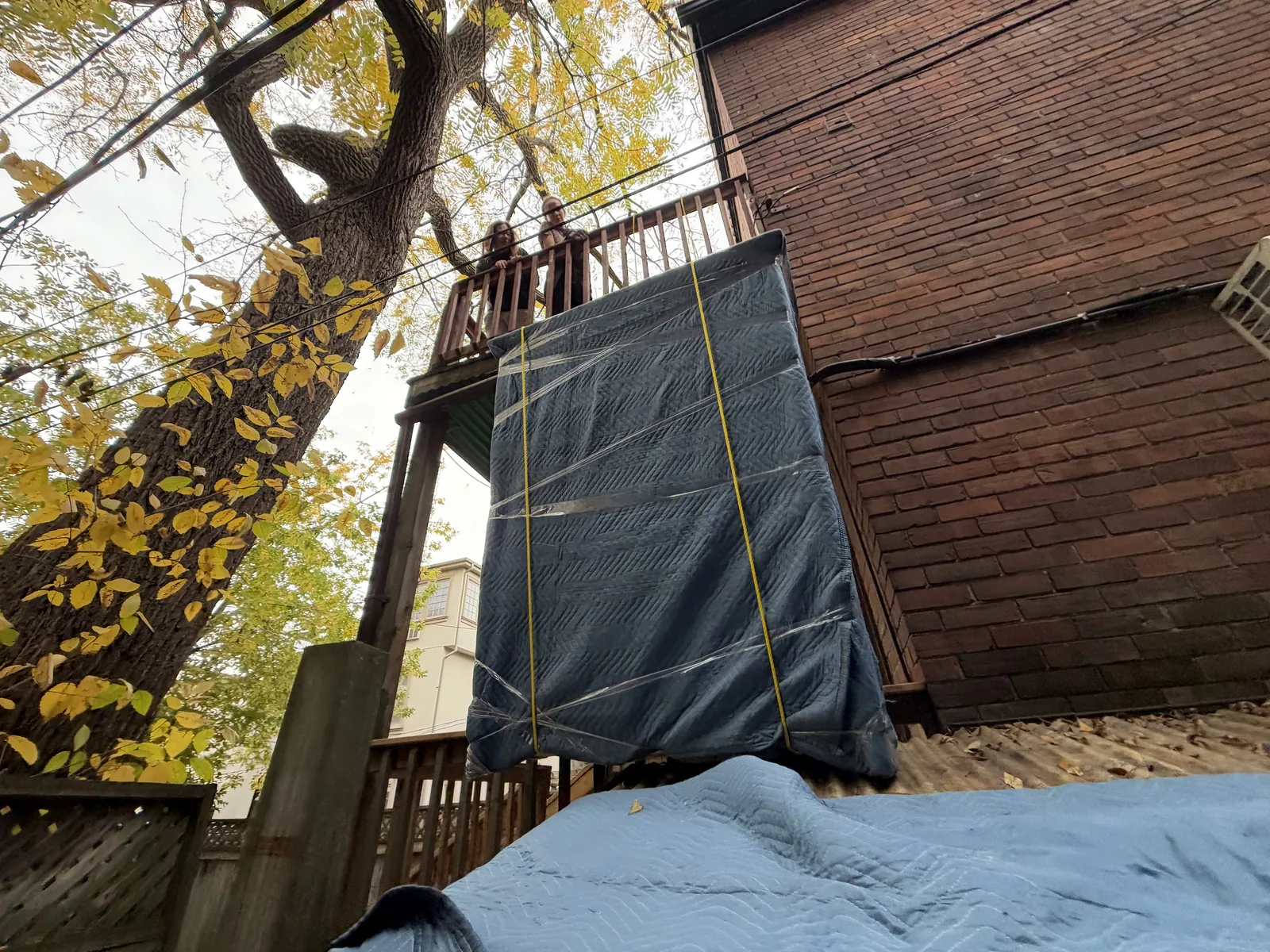
The primary bedroom had a small balcony at the back, about 12 feet above the yard. So the dresser went out that way:
- The drawers stayed in. They were already empty, and the plastic wrap held them shut.
- The dresser was wrapped in blankets and plastic wrap, with cardboard on the corners.
- Two ropes ran lengthwise around it, so it hung upright on its end and could not slip out.
- The rope went around a balcony post. Two movers on the balcony lowered it slowly, with the post taking most of the weight.
- The third mover stood in the yard and guided it down, keeping it away from the wall and the railing.
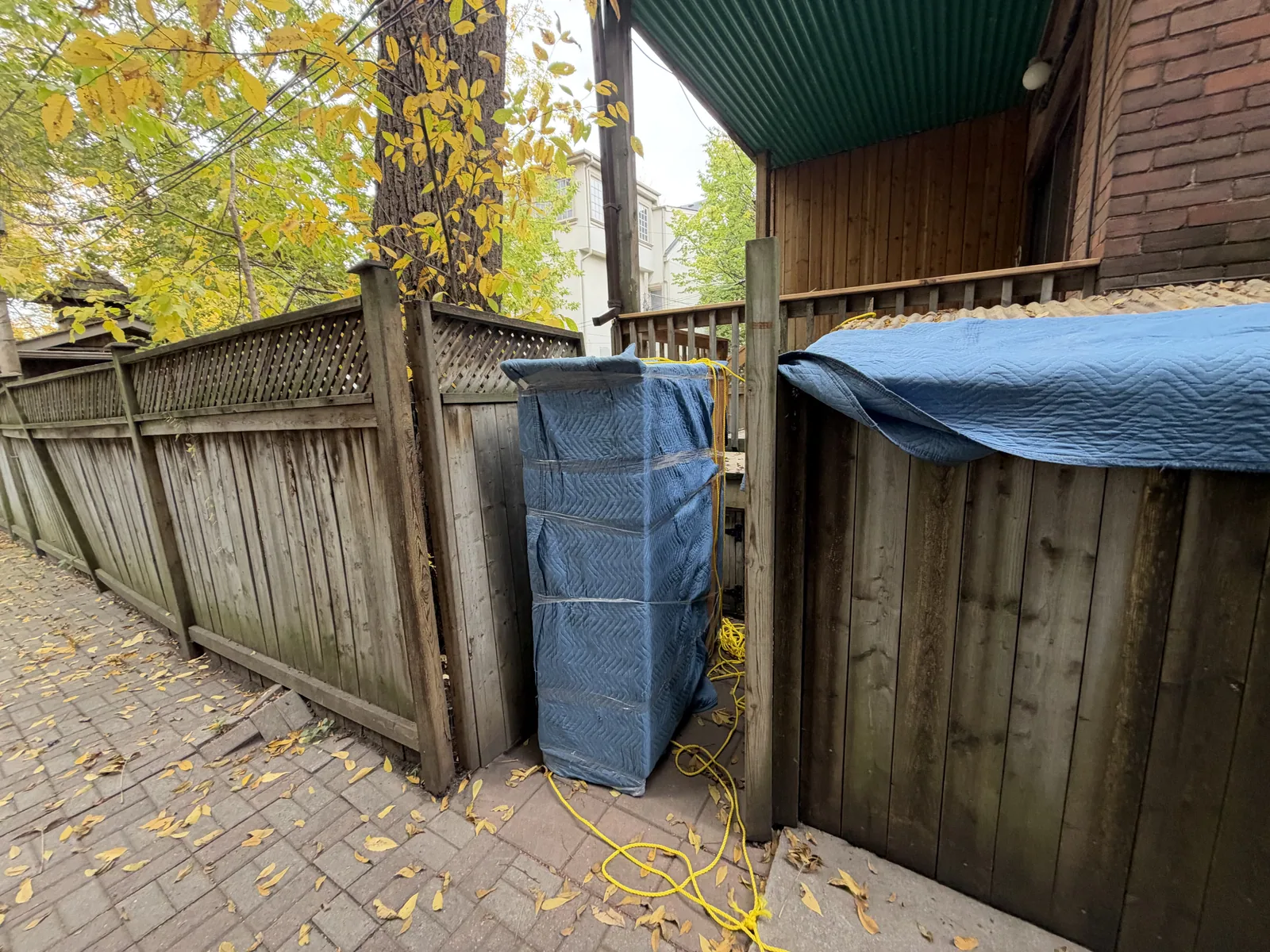
It took about 40 minutes from start to finish, including the setup. The dresser touched down on moving blankets laid out below without a scratch, and the house did not get a mark either. In Port Credit it went up the wide stairs on two movers' shoulders in under five minutes.
A word of caution: this is not something to try with friends and a clothesline. For us it is a last resort that we use only now and then, and it needs a balcony or window strong enough to take the load, rope rated for the weight, a clear and safe landing spot, and a crew that has done it before.
How long it took
The move took about 8.5 hours from arrival in Etobicoke to the final walkthrough in Mississauga. The balcony added about 40 minutes. Trying the stairs again and again, or taking the dresser apart, would have taken longer and risked damage to both the dresser and the walls.
What the two moves have in common
The two houses were different and so was the problem piece, but the same few things kept both days on schedule.
- The inventory came in before move day. The crew size and the time were planned around real furniture, not a guess.
- The boxes were packed and labelled by room. Packed boxes go out on a dolly in stacks; loose items go out one at a time.
- Parking was sorted out at both ends. A driveway in one case, and two street spots kept clear by the neighbours in the other.
- The tricky piece was handled on the spot. In both cases the crew worked through the usual options in order and picked the one that kept the furniture and the house undamaged.
- The extra time was small. Twenty-five minutes for a door and forty for a balcony, on days of seven and eight and a half hours.
How to get a couch through a door, or a dresser down the stairs
When a couch won't fit through the door, or a dresser stops at a landing, there is an order to try things in. Each step costs a little more time than the one before it, so the crew moves down the list only when it has to.
Try every angle first
Upright, on its side, on its end, and hooked through the opening back first. A sofa that will not go in flat often goes in standing on end with its back curved around the frame. This costs a few minutes and nothing else.
Take off the legs, the feet or the door
Screw-on sofa legs and bun feet come off in a minute and can add an inch or two of clearance. If that is not enough, the door comes off its hinges, along with the storm door, as it did in Leslieville. The frame gets wrapped in blankets so the trim stays safe, and the doors go back on before the crew leaves.
Take the furniture apart, when it is built for it
Bed frames, many wardrobes, sectional sofas and most flat-pack furniture are designed to come apart. Taking these apart and putting them back together is included in the hourly rate. Old glued furniture is another matter, and the crew will tell you if a piece should not be taken apart.
Moving heavy furniture down stairs
Going down, the usual rule is that the heavier end goes first with a mover below it taking the weight, and the piece travels on its back or on its end, whichever clears the turn. Drawers come out or get emptied and wrapped shut, and the stair edges and the wall at the landing get padded first. If the piece is still too tall to tip under the ceiling at the landing, no amount of strength will get it round, and it is time for the last option.
Moving furniture over a balcony or out of a window
If a piece came in through a window, or before the stairs were rebuilt, it may have to leave the same way. Lowering a piece on ropes from a balcony or a large window can work when the structure is strong enough and there is a safe landing spot below. We do it now and then, but it is the last option, not the first, and it is only worth it for a piece that is worth keeping.
What a house move like this costs
Local moves at Moovy are billed by the hour: $119 for two movers, $169 for three and $219 for four, with a three-hour minimum and 15-minute increments after that. One truck fee is added on top, set by the round trip from our base to your address. It is $100 within 20 km and rises with distance. HST is extra.
For the two moves above, that works out like this:
- Midtown to Leslieville: about 7 hours with three movers, around $1,183 in labour before the truck fee and HST.
- Mimico to Port Credit: 8.5 hours with three movers, around $1,437 in labour before the truck fee and HST.
The door removal in Leslieville cost the clients roughly $70 of crew time. The balcony in Mimico cost roughly $113. Stairs, heavy pieces and tricky doorways do not carry a separate fee; they only add time.
The second move landed at the short end of the 8.5 to 10 hours we plan for a three-bedroom house, even with the balcony. That was the packed boxes, clear parking at both ends and a driveway at the new house. The full table by house size is on our house movers in Toronto page, and every crew rate is on the moving rates page.
House moving tips for older homes: 10 checks before moving day
Most of the time on moving day is decided before the truck arrives. These are the checks that made both moves above go smoothly.
- Measure your biggest pieces. Write down the width, depth and height of the sofa, dressers, wardrobes, headboards and the fridge.
- Measure the narrowest points. That means the front door with the storm door open, hallway corners, the stair width and the ceiling height over any landing, at both houses.
- Photograph the stairs and the entrances. Take one photo from the top of the stairs, one from the landing and one of each front door. Send them with your inventory, and we can usually tell from a photo whether a piece will make the turn.
- Tell us about anything that came in a different way. If a piece came through a window or was built in the room, it probably will not leave by the stairs, and the crew can come prepared.
- Send a full inventory ahead of time. The more accurate the list, the better we can choose the crew size and plan the day.
- Empty every drawer. A full nine-drawer dresser can weigh twice as much as an empty one, and clothes shift and make it harder to balance.
- Pack and label boxes by room. Write the room on the top and on one side so each box goes straight where it belongs.
- Sort out parking at both ends. Keep the spots in front of the house clear, ask the neighbours the evening before, and park your own car elsewhere for the day.
- Clear the basement path. Basement stairs are often the narrowest in the house, so move boxes and clutter away from them before the crew arrives.
- Have keys and access ready at the new house, and put a sign on each door, like "Kids' room" or "Office". The crew can then place everything without stopping to ask.
For the weeks before the move, our room-by-room house moving checklist walks through each part of the house in order. If you are mainly worried about one big piece, we also wrote about moving heavy furniture in Toronto.
Frequently asked questions
How do you get a couch through a door that seems too narrow?
Measure the couch's depth and the doorway's width with the door open. If the depth is close to the width, stand the couch on end and hook it through back first, then take off the legs, and if needed the door itself. In Leslieville, a 37-inch-deep sofa went through a 30-inch doorway once the door was off its hinges.
Do you charge extra for stairs or heavy furniture?
No. There are no stair or heavy-item fees. Stairs and heavy pieces add time, and time is what you pay for, so describe them when you request your quote and we will send the right crew size.
Will you take a door off its hinges to get furniture in?
Yes, when it is the safest way through. The crew pulls the hinge pins, protects the frame with blankets and puts the door back on before leaving.
How long does it take to move a 3-bedroom house?
We plan 8.5 to 10 hours with three movers for a typical 3-bedroom house. A well-packed house with good parking lands at the short end, like the Etobicoke move above, which took about 8.5 hours including 40 minutes to lower a dresser from the balcony.
How long does it take to move a 2-bedroom house?
Plan on 5 to 7 hours. With two movers a lighter, well-packed house sits at the shorter end; heavier inventory or more stairs makes a crew of three worth it. The Midtown move above took about 7 hours with three movers, including 25 minutes to take a door off and put it back.
Do you take furniture apart and put it back together?
Yes, it is included in the hourly rate. We only take apart what has to come apart to get out the door, such as bed frames, and we put it back together at the new house.
Planning a move out of an older house?
Narrow doors, steep stairs and street parking are part of moving in Toronto, Etobicoke and Mississauga. With an accurate inventory and a crew that knows what is coming, they are a problem to solve on the day, not a reason to leave furniture behind.
At Moovy, blanket wrapping, mattress bags, floor runners and taking furniture apart and putting it back together are included in the hourly rate. There is no deposit and no cancellation fee, and every move is covered by $2,000,000 in commercial general liability insurance. Our crews move houses across the city and the GTA, including Etobicoke movers and Mississauga movers teams.
Send us your inventory and a few photos of your stairs and doors, and we will tell you the crew size and time before moving day. Get a free moving quote or call us at (647) 948-6688. We are open seven days a week, 9 AM to 7 PM.